Have you experienced that sinking feeling that comes about ten seconds into the job, when the lance is already running and the first tile has gone pale and powdery where the water hit it? By then it is too late. Across London, original Victorian path tiles – those black, red, buff and cream geometric patterns running from the front gate to the porch – are being quietly destroyed every weekend by well-meaning homeowners with a hired pressure washer and the best of intentions. The paths look filthy, the moss has taken hold, and a 3000 PSI machine seems like the obvious answer. It is, in fact, one of the worst things you can do to them. These tiles have survived a century and a half of London weather and several thousand pairs of muddy boots. What they often do not survive is a single afternoon with the wrong cleaning method, and understanding why means understanding what these paths actually are.
What Makes Victorian Path Tiles So Vulnerable?
Victorian path tiles are vulnerable because their value lives in a thin surface layer and a soft, lime-based foundation, both of which high pressure attacks directly. The tile body itself is often surprisingly tough, but the path as a whole is a delicate historic system rather than a single hard slab, and that distinction is exactly what catches people out.
Geometric and Encaustic – Two Different Beasts
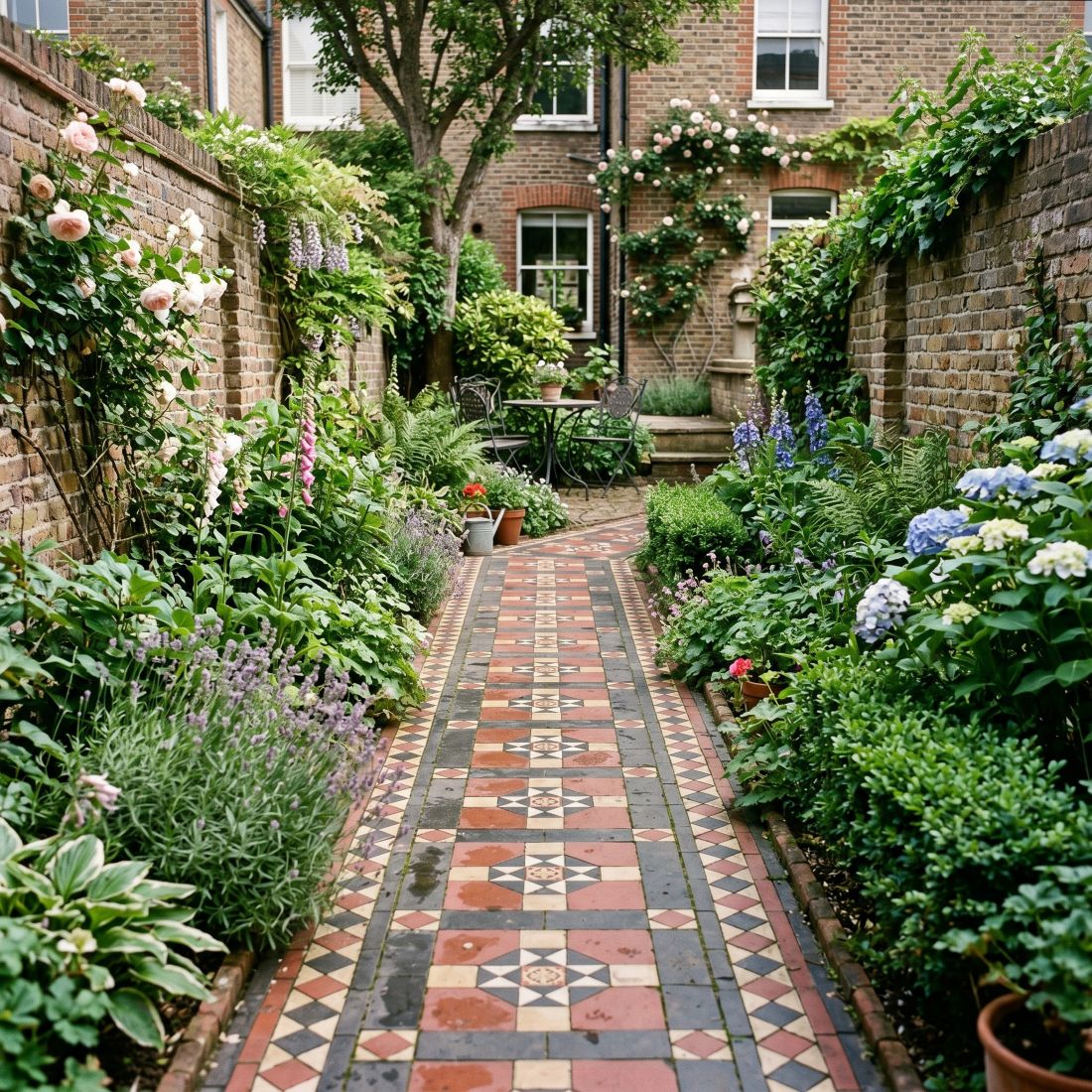
Most London front paths use geometric tiles, and a smaller number use encaustic tiles, and the difference matters when you are cleaning them. Geometric tiles are unglazed and fired from natural clays, so the colour runs all the way through the body – the red is iron-rich clay, the black is often a manganese-stained clay, the buff and white come from different seams entirely. They were cut into squares, triangles, hexagons and lozenges and laid in repeating patterns by firms such as Minton, Maw & Co and Craven Dunnill from roughly the 1850s through to the Edwardian era. Encaustic tiles go a step further: the pattern is inlaid using different coloured clays set into the tile face before firing, so a decorative motif is built into the material itself. Both types share one feature that defines how you must treat them. The surface you see has a worn patina built up over decades, and once that is blasted away it does not come back.
The Joints Are the Weak Point
The real fragility of a Victorian path is not the tiles but everything holding them together. These paths were typically bedded on lime mortar or a lime-and-sand mix, and pointed with the same soft material, long before modern cement was standard. Lime is deliberately softer than the tiles, because it is meant to flex and breathe and take up movement without cracking the ceramic. A high-pressure jet finds those joints instantly. Directed along a line of pointing, even at a modest angle, the water excavates the lime, scours out the bedding beneath and leaves tiles sitting loose over a hollow void. Within weeks they rock underfoot, water collects below them, and the whole section begins to lift. The tiles might be perfectly intact and still be ruined, because the path that supported them has been washed out from between them.
Why Does Pressure Washing Ruin These Tiles?
Pressure washing ruins Victorian tiles because it removes the patina, opens the porous body to water and destroys the soft jointing, turning a stable historic surface into a fragile, saturated one. The damage is rarely obvious in the first minute, which is precisely why people keep going until it is done.
What 3000 PSI Actually Does to a 150-Year-Old Path
A pressure washer set for concrete does measurable physical damage to an unglazed Victorian tile. The jet abrades the worn surface layer, exposing a rougher, more open body underneath that looks lighter and chalkier – that pale patch is not the tile getting clean, it is the tile getting eroded. On encaustic tiles the inlaid pattern is shallow, and aggressive blasting thins it, softening the crisp edges that gave the design its definition. Where a tile already has a hairline crack, and most century-old tiles have a few, the pressure drives into it and lifts a flake clean off. None of this is reversible. Reproduction geometric tiles are made today by a handful of specialists, but matching the exact colour, wear and tone of an original Victorian path is effectively impossible, so every tile lost is a permanent gap in the pattern.
The Frost-Damage Time Bomb
The worst harm from pressure washing an unglazed tile often appears months later, in the first hard frost. Once the worn surface is stripped, the tile body beneath is far more porous and soaks up water like a sponge. London winters deliver repeated freeze-thaw cycles, and water trapped in a saturated tile expands as it freezes, popping the surface off in flakes in a process called spalling. A path that looked clean and bright in September can be crumbling at the edges by February, and the homeowner rarely connects the two events. This delayed failure is one reason pressure-washing damage is so underestimated.
The Acid Mistake That Is Even Worse Than the Lance
If there is one thing more destructive to a Victorian path than a pressure washer, it is a bottle of spirit of salts. Spirit of salts is hydrochloric acid, sold cheaply in builders’ merchants and widely recommended in online forums for cleaning tiles and brick, and it is catastrophic on a historic path. The acid attacks the lime mortar far faster than it touches the dirt, eating out the joints and weakening the bedding. It reacts with iron compounds in the clay, which can leave permanent yellow or orange staining that no amount of subsequent cleaning will lift. On encaustic tiles it can etch and dull the inlaid colours. People reach for it because it produces a dramatic fizzing reaction and an instant visual change, mistaking chemical damage for cleaning power. The fizzing is the path dissolving. Combined with a pressure washer to rinse off the residue, it inflicts both kinds of damage in a single afternoon, which is sadly a common sequence on the paths that come to us beyond saving.
How Should You Actually Clean a Victorian Tiled Path?
You clean a Victorian tiled path with patience, gentle tools and pH-neutral products, working with the material rather than overpowering it. The method is slower than blasting, but it is the only approach that leaves the path in better condition than it started.
Start by Identifying What You Have
Before any cleaning, work out what your path is made of and what condition it is in. Look for loose or rocking tiles, missing pointing, hairline cracks and any previous repairs in hard cement, which often sit higher and lighter than the original lime. Check whether the surface has an old finish on it – many Victorian paths were historically dressed with boiled linseed oil, and later ones may carry decades of wax or an old sealant that needs lifting first. Knowing whether you are dealing with bare geometric tile, an oiled surface or a sealed one changes how you proceed.
The Gentle Method That Works
A stiff brush, warm water and a pH-neutral cleaner will lift most London grime without harming anything. Start by clearing loose moss and debris with a hand brush or a plastic scraper, taking care not to gouge the joints. Apply a pH-neutral tile cleaner diluted as directed, give it time to work into the dirt rather than scrubbing dry, and agitate with a medium-stiff brush rather than a wire one. Black spotting from lichen often needs a specialist biocide left to dwell over several days, not force – the organism has to die and release its grip, which scrubbing alone will not achieve. Rinse with a hose at normal mains pressure or a watering can. If a pressure washer is genuinely unavoidable for a final rinse, set it well below 1000 PSI with a wide fan nozzle, held well back and never aimed into the joints. For most paths it is simply not needed.
Sealing – and the Sealant Trap
Sealing a cleaned Victorian path protects it, but only if you use a breathable sealer rather than a surface film. The body of these tiles needs to let moisture move through it and evaporate; that is how it has coped with ground damp for over a century. An impregnating or penetrating sealer soaks in and repels water while still allowing the tile to breathe. A cheap surface-film sealer does the opposite, laying a plastic-like skin over the top that traps moisture underneath, and on a path drawing damp from the ground that trapped water leads straight back to spalling and a milky, peeling finish. The right sealer is invisible and breathable; the wrong one looks impressive for a season and then fails. After sealing, the traditional linseed-oil dressing can still be used on bare geometric tiles to deepen the colour, though it needs occasional renewal.
Why London Terraces Are Especially at Risk
London concentrates more original Victorian tiled paths than almost anywhere, which is exactly why so many are being lost. Streets across Islington, Hackney, Camden, Stoke Newington, Walthamstow, Dulwich and Clapham were built out during the great terrace boom of the 1860s to 1900s, and an enormous number retain their original front paths. Many sit within conservation areas, where these features contribute to the character the designation is meant to protect, and a few are on listed buildings, where altering or damaging original fabric can carry real consequences. The combination of soft historic materials, a damp climate, hard winters and a steady supply of hired pressure washers makes the capital’s paths uniquely exposed. A path like this is genuinely irreplaceable – once the pattern is broken and the tiles are gone, the most you can hope for is a reproduction that never quite matches. Treating it as the historic object it is, rather than as a dirty bit of ground to be blasted clean, is the difference between a path that lasts another hundred years and one that does not see out the decade.