When a patio turns green or a driveway goes black, the question most London homeowners ask is not really how to clean it but what is the least painful way to deal with it. Should you spend a Saturday on your knees with a brush, reach for a bottle of something that promises to do the work for you, hire or buy a pressure washer, or simply give up and pay to have the whole lot dug up and replaced? Each of these gets sold as the efficient choice by someone, and each of them genuinely is the efficient choice – but only for a particular surface, a particular kind of dirt and a particular budget. The expensive mistakes happen when the method is matched to the mood rather than the job: scrubbing something far too big, blasting something far too delicate, or replacing something that only needed an afternoon’s attention. Working out what is actually most efficient means being honest about what efficiency even means here, because it is not a single thing.
What Does “Efficient” Actually Mean When Cleaning Outdoors?
Efficiency outdoors is a balance of four things: time, cost, effort and how long the result lasts. A method that cleans a surface in an hour is not efficient if the green is back in three months, and a cheap approach is not efficient if it damages the surface and forces an early replacement. The hidden fifth factor is risk – the chance that the method itself harms what you are cleaning – because a clean that wrecks the surface is the least efficient outcome of all, no matter how quick or cheap it looked at the time. The right way to judge any of these methods is therefore not “how fast and cheap is it today” but “what does it cost in money, effort and damage to get a result that actually lasts”. Held to that standard, the four approaches sort themselves out quite clearly, and the answer changes with the surface in front of you. It is worth saying plainly that there is no universal winner here, only a best fit for each particular job, which is precisely why the same homeowner can be right to scrub one surface and blast another on the same afternoon.
How Efficient Is Manual Scrubbing?
Manual scrubbing is the cheapest method in materials and the most controllable, but by far the most expensive in time and effort. With nothing more than a stiff brush, some water and a little detergent, you can clean almost any surface without the slightest risk of damaging it, which is exactly why it remains the right answer for delicate and historic materials that a jet would destroy. The catch is human stamina. Scrubbing a small set of steps or a patch of staining is perfectly sensible; scrubbing an entire driveway by hand is a punishing job that few people finish, and the result is rarely as even as a machine would give. Its real efficiency lies in small, delicate or awkward areas – the places where the gentleness is worth the labour and the area is small enough that the labour stays reasonable. On anything large, the sheer hours involved make it the least efficient choice available.
How Efficient Is Chemical Cleaning?
Chemical cleaning is highly efficient when it is matched to the right problem, because it does the work that force otherwise has to. A biocide kills algae, moss and lichen down to the root, so the surface stays clean for far longer than any purely physical clean – that longevity is genuine efficiency, since you clean less often. A degreaser lifts oil that a pressure washer would only spread around, and a poultice draws out a specific stain with no effort and no risk. The cost in physical labour is low, and the materials are inexpensive relative to the result. There are two real catches. The first is time: most treatments need to dwell, so the job is slower in the moment even if it saves time over the years. The second is care – the wrong chemical, particularly an acid, can do lasting harm, and any strong solution needs handling that protects plants, surfaces and drains. Used correctly and matched to the dirt, though, chemistry is often the most efficient single component of any clean.
How Efficient Is Pressure Washing?
Pressure washing is the most efficient method for large, hard, robust surfaces carrying heavy dirt, and a liability almost everywhere else. On a sound concrete driveway or a tough paved patio, nothing else comes close – it covers a big area fast, shifts ingrained grime that scrubbing would take days to touch, and uses only water. For exactly that kind of job, its efficiency is unmatched. The trouble is that the same speed and force become pure cost on the wrong surface. It does not kill biological growth, so on a green wall the staining returns within months and you are simply doing the job again. On soft brick, render, roofs or old tiles it strips, cracks and erodes, converting a cleaning job into a repair bill. And on block paving it blasts out the jointing sand that holds the surface together. Pressure washing is brilliantly efficient inside its lane – hard, horizontal, durable, dead dirt – and quietly ruinous outside it, which is why so much apparent time saved turns into money lost.
When Is Replacement the Most Efficient Option?
Replacement is the most efficient option only when the surface is genuinely beyond saving, and a waste of money in every other case. This is the choice people reach for either too soon or too late. Cleaning a driveway that has sunk, cracked and lost its structure, or decking that has rotted through, is throwing good effort after bad – no amount of washing fixes a failed surface, and the hours spent cleaning it are simply lost on top of the replacement you will need anyway. In that situation, skipping straight to replacement is the efficient call. But replacement is also the most expensive, disruptive and wasteful option by a wide margin, especially in London, where labour, skip hire and waste disposal all carry a premium. Tearing out and relaying a surface that only needed a proper clean is the single most inefficient thing on this list. The honest test is whether the surface is dirty or whether it has actually failed – clean the first, replace the second, and do not confuse the two.
How Do the Methods Compare on Cost?
The four methods line up almost exactly in reverse when you rank them by upfront cost rather than effort. Scrubbing is the cheapest by far in materials – a brush and some detergent – but the most costly in your own time, which is the trade that defines it. Chemical cleaning is inexpensive in materials too, with biocides and degreasers costing little relative to the area they treat, and its low labour makes it one of the best-value options when matched to the right problem. Pressure washing sits in the middle: hiring a machine for a day or buying a domestic one is a real but modest outlay, and the cost rises sharply only if the wrong surface turns the job into a repair. Replacement is in a different league entirely, with materials, labour, skip hire and disposal all stacking up, and in London those last two carry a premium that can dwarf the cost of the surface itself. The pattern worth noticing is that the cheapest method on the day and the cheapest method over ten years are rarely the same one – a biocide that costs more than a bottle of patio cleaner but keeps a wall clean for years is the better value, and a pressure wash that damages soft brick is the most expensive clean of all once the repair arrives.
So What Is Actually Most Efficient?
The most efficient approach is almost never a single method – it is the right combination matched to the surface and the dirt. In practice the best results usually come from pairing chemistry with a physical method: a biocide to kill the growth at the root, then a gentle rinse or a careful pressure wash to clear the dead material, giving both a fast clean and a lasting one. Scrubbing handles the delicate spots, pressure handles the big hard expanses, chemicals handle the living growth and the stubborn stains, and replacement is held back for the surfaces that have genuinely reached the end.
A Surface-by-Surface Rule of Thumb
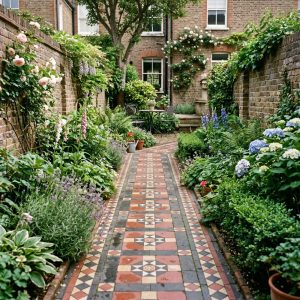
The quickest way to choose is to read the surface and the dirt together. A sound concrete or paved driveway carrying mud and grime wants pressure washing. A green or black wall, roof or render wants a biocide and low pressure, because the stain is alive and force alone will not keep it away. A small, delicate or historic surface – an original tiled path, soft old brick, a wooden porch – wants hand scrubbing or a gentle chemical treatment and nothing more aggressive. An oil patch wants a degreaser. And a surface that has cracked, sunk or rotted past use wants replacing, not cleaning. Match each surface to its method and you waste nothing. For a typical London property, that might mean pressure washing the driveway, soft washing the render and roof, scrubbing the original tiled path by hand and treating the shaded north wall with a biocide – four methods, four surfaces, each chosen on its merits. The single biggest source of wasted money and effort is loyalty to one method, whether that is blasting everything with a pressure washer or replacing everything out of impatience. Efficiency is not a tool you own; it is the judgement to match the method to the job, and on a mixed older property that judgement is worth more than any machine.